
Schedule II depreciation calculator
Companies Act 2013 depreciation for one asset, year by year from the date it was put to use. Pick the Schedule II class, choose SLM or WDV and download the schedule.
- ₹6,333.33
- ₹5,000
- 31 Mar 2041
- ₹95,000
Year-by-year schedule
| Financial year | Days | Opening | Depreciation | Closing | Accumulated |
|---|---|---|---|---|---|
| FY 2026-27 | 365/365 | ₹1,00,000.00 | ₹6,333.33 | ₹93,666.67 | ₹6,333.33 |
| FY 2027-28 | 366/366 | ₹93,666.67 | ₹6,333.33 | ₹87,333.34 | ₹12,666.66 |
| FY 2028-29 | 365/365 | ₹87,333.34 | ₹6,333.33 | ₹81,000.01 | ₹18,999.99 |
| FY 2029-30 | 365/365 | ₹81,000.01 | ₹6,333.33 | ₹74,666.68 | ₹25,333.32 |
| FY 2030-31 | 365/365 | ₹74,666.68 | ₹6,333.33 | ₹68,333.35 | ₹31,666.65 |
| FY 2031-32 | 366/366 | ₹68,333.35 | ₹6,333.33 | ₹62,000.02 | ₹37,999.98 |
| FY 2032-33 | 365/365 | ₹62,000.02 | ₹6,333.33 | ₹55,666.69 | ₹44,333.31 |
| FY 2033-34 | 365/365 | ₹55,666.69 | ₹6,333.33 | ₹49,333.36 | ₹50,666.64 |
| FY 2034-35 | 365/365 | ₹49,333.36 | ₹6,333.33 | ₹43,000.03 | ₹56,999.97 |
| FY 2035-36 | 366/366 | ₹43,000.03 | ₹6,333.33 | ₹36,666.70 | ₹63,333.30 |
| FY 2036-37 | 365/365 | ₹36,666.70 | ₹6,333.33 | ₹30,333.37 | ₹69,666.63 |
| FY 2037-38 | 365/365 | ₹30,333.37 | ₹6,333.33 | ₹24,000.04 | ₹75,999.96 |
| FY 2038-39 | 365/365 | ₹24,000.04 | ₹6,333.33 | ₹17,666.71 | ₹82,333.29 |
| FY 2039-40 | 366/366 | ₹17,666.71 | ₹6,333.33 | ₹11,333.38 | ₹88,666.62 |
| FY 2040-41 | 365/365 | ₹11,333.38 | ₹6,333.38 | ₹5,000.00 | ₹95,000.00 |
Indicative calculations. Confirm with your Chartered Accountant before filing.
Assumptions used
- Financial year 1 April to 31 March. Depreciation runs from the date put to use, pro-rata by days (both days counted), divided by the days in that year (365 or 366).
- SLM: (cost − residual) ÷ useful life per full year. WDV: rate = 1 − (residual ÷ cost)^(1 ÷ life), rounded to two decimals of a percent, applied to the opening value.
- Useful life ends the day before the anniversary of the date put to use. In that year the charge brings the value down to the residual value exactly; no year goes below it.
- Extra shift adds 50% (double) or 100% (triple) to the normal charge of every year shown; it is not offered for classes marked NESD. Shift working in only part of a year is not modelled here.
- When the schedule starts in a later year, prior depreciation reduces the opening value; the SLM charge and WDV rate stay as originally set.
- Useful lives: Schedule II Part C reference data, version 2026.09.1. Amounts are rounded to the paisa each year.
Frequently asked questions
How is the WDV rate worked out under Schedule II?
Schedule II prescribes useful lives, not rates. The WDV rate is derived from the life and residual value: rate = 1 − (residual value ÷ cost)^(1 ÷ useful life). With a 5% residual and a 10-year life that is about 25.89%; for 15 years about 18.10%.
Can the residual value be more than 5%?
Part A of Schedule II says the residual value shall not ordinarily be more than 5% of the original cost. A company that uses a higher residual value (or a different life) has to disclose the justification, usually technical advice, in its financial statements.
How does pro-rata work in the first year?
Note 2 to Part C requires depreciation pro rata from the date of addition. The calculator counts the days from the date put to use to 31 March (both days included) and charges that fraction of a full year.
When does extra-shift depreciation apply?
Part C lives assume single-shift working. For any period an asset works double shift, depreciation for that period goes up by 50%; triple shift by 100%. It does not apply to items marked NESD (no extra-shift depreciation), such as buildings, furniture and vehicles.
Is this the same as income-tax depreciation?
No. The Income-tax Act uses block-of-assets WDV rates from Appendix I with a half-rate rule for assets used less than 180 days. Use the Income-tax depreciation calculator for that book.
Learn more in our guides
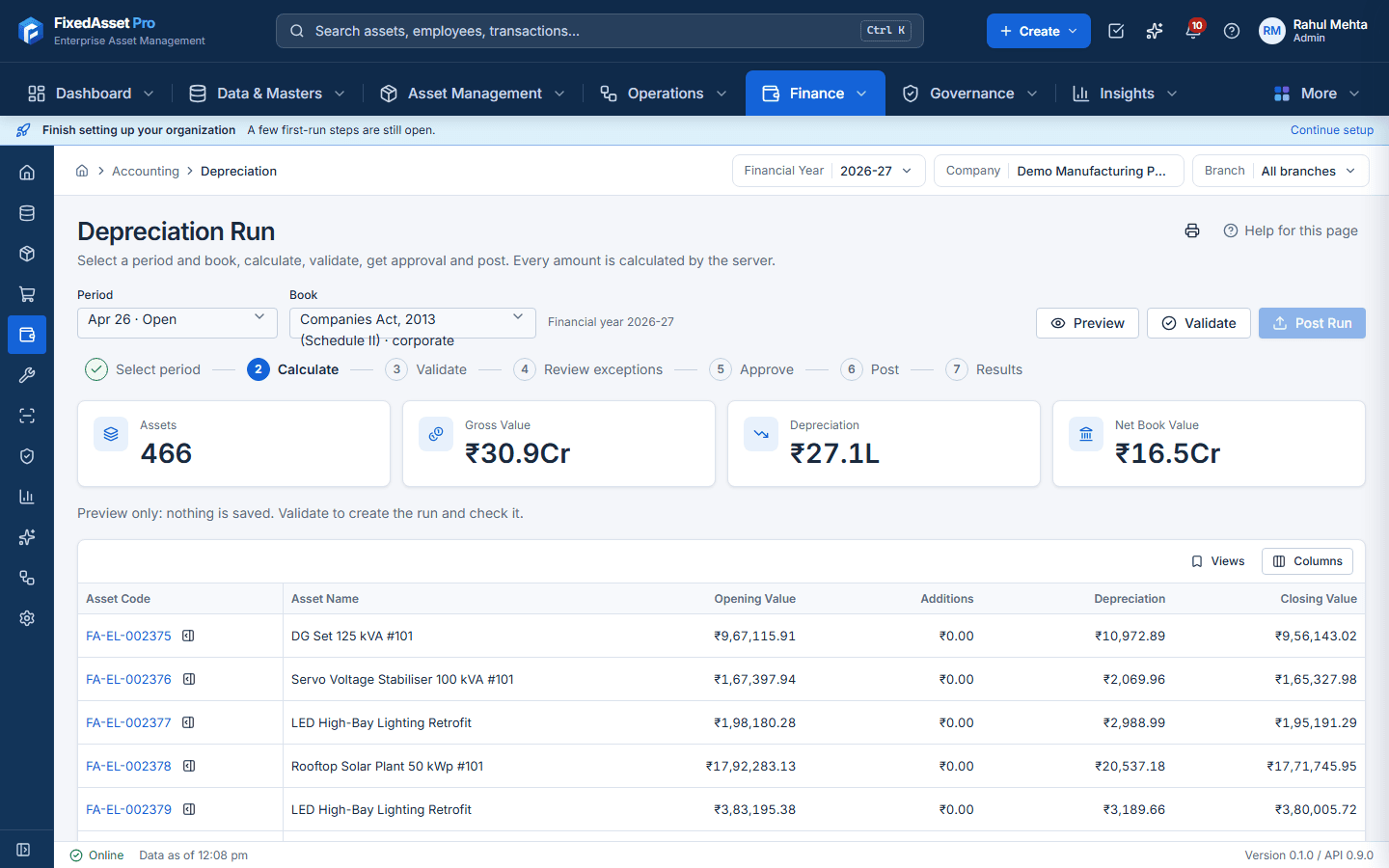
Automate this in FixedAsset Pro
FixedAsset Pro runs this schedule for every asset in the register, with additions, disposals, component lives and the Income-tax book alongside, and keeps the audit trail your auditor asks for.