
Key takeaways
- Clause 3(i) of CARO 2020 covers the asset records, physical verification, title deeds, revaluation and benami proceedings; the auditor reports on each, but the records and the verification are management's job.
- CARO does not define 'reasonable intervals'. Covering every asset over a planned cycle is common practice, but the cycle is a judgment for management, reviewed by the auditor.
- A verification is only as good as its reconciliation: every discrepancy needs an investigation, a decision, an approval and, where needed, an entry in the books.
- Keep the plan, count records, reconciliation, approvals and journals together; that file is what the auditor will ask for.
On this page
What clause 3(i) asks
The Companies (Auditor's Report) Order, 2020 (CARO 2020) applies to audits for financial years beginning on or after 1 April 2021. It does not apply to every company: banking and insurance companies, section 8 companies, one person companies, small companies and certain private companies below the prescribed thresholds are excluded. Check applicability with your auditor.
Clause 3(i) is the fixed-asset clause. The auditor reports on each sub-clause, so management needs records that answer each one.
| Sub-clause | What the auditor reports on | What management should have ready |
|---|---|---|
| (a)(A) | Proper records showing full particulars, including quantitative details and situation, of property, plant and equipment | A register with quantity, unit, location and custodian for every asset |
| (a)(B) | Proper records showing full particulars of intangible assets | An intangible asset register |
| (b) | Physical verification by management at reasonable intervals; whether material discrepancies were noticed and properly dealt with in the books | The verification programme, count results, discrepancy reconciliation and the entries passed |
| (c) | Whether title deeds of immovable property (other than where the company is lessee under a duly executed lease) are held in the company's name; if not, prescribed details | Per property: description, gross carrying value, holder's name, relationship to promoter or director, period held and reason |
| (d) | Revaluation of PPE (including right-of-use assets) or intangibles during the year; whether by a registered valuer; the change if 10% or more in aggregate of the net carrying value of a class | Revaluation records with valuer, date and amount, and the percentage change per class |
| (e) | Proceedings initiated or pending under the Benami Transactions (Prohibition) Act, 1988, and whether disclosed | A note of any such proceedings and the related disclosure |
This guide concentrates on sub-clause (b), the one that needs a planned exercise every year. Sub-clause (a)(A) depends on it too: a register cannot show the 'situation' of assets reliably unless someone checks it.
What 'reasonable intervals' means
CARO 2020 does not prescribe a frequency. Whether an interval is reasonable depends on the nature, value, number and location of the assets and on how easily they can be moved or lost. The judgment belongs to management, and the auditor assesses whether the programme is reasonable.
A pattern often seen in practice is a phased programme in which every asset is covered over a cycle, for example once in three years for some categories, with portable or high-risk items counted more often. This is one way of reaching a reasonable interval, not a rule.
| Asset group | Risk factors | Possible frequency |
|---|---|---|
| Laptops, mobile phones, tools, test equipment | Portable, attractive, high turnover of custodians | Every year, or more often |
| Vehicles | Mobile, but registered and insured | Every year |
| Office furniture and fittings | Many low-value items, rarely moved | Over a cycle, part each year |
| Fixed plant and machinery | Heavy, installed, hard to remove | Over a cycle, part each year |
| Land and buildings | Existence supported by title records | Over a cycle, with title verification |
| Assets at third-party sites, job workers or projects | Outside direct control | Every year, with confirmations where a visit is impractical |
Write the programme down and get it approved. A documented plan with coverage tracked against it is far easier to defend than a count that happened to take place.
Planning a verification
Scope and cut-off
Decide which branches, locations and categories are in this round and whether it is a full count or a sample. Fix a cut-off date and freeze movements, or record them, so the count compares against a known register position.
Teams
Counting teams should, where possible, not be the custodians of the assets they count. Pair someone who knows the site with someone independent of it, and brief them on what each outcome means.
Tags and count sheets
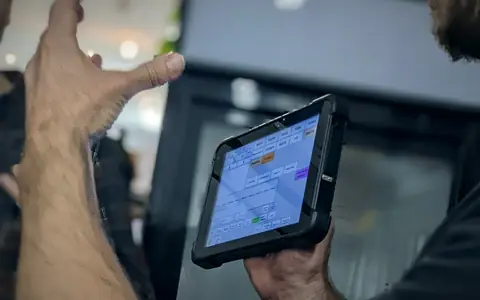
Every asset should carry a durable tag that links it to one register record, and each room or area should have a location label. Where scanning is not available, print count sheets per location listing the expected assets, with space for unlisted items found. Our guide on QR, barcode and RFID tagging covers the choices.
Rules for outcomes
Agree in advance how each result is classified: verified, missing, found at another location, with a different custodian, damaged, or found but not in the register. Agree also what evidence each outcome needs, such as a photo for damaged items or a signature for a custodian change.
Counting and reconciliation
Count against the register, not from it. A blind count, where the counter does not see the expected list, reduces the risk of ticking items that are not there. Record the date, the counter and the location for each sighting.
Reconciliation then compares what was found with what the register shows. Each difference goes into a queue and is investigated before anything is written off:
- found elsewhere: an unrecorded transfer; record the transfer with approval;
- custodian mismatch: update the assignment with an acknowledgement;
- not found: search again, check disposal and repair records, then propose recovery or write-off;
- found but not in the register: trace the purchase; the item may have been expensed, received free, or never capitalised.
| Category | Per register (nos) | Found at recorded location | Found elsewhere | Not found | Found, not in register | NBV of not found |
|---|---|---|---|---|---|---|
| IT equipment | 420 | 389 | 22 | 9 | 3 | ₹1,18,400 |
| Furniture and fittings | 610 | 596 | 11 | 3 | 6 | ₹14,250 |
| Plant and machinery | 85 | 84 | 1 | 0 | 0 | Nil |
| Vehicles | 12 | 12 | 0 | 0 | 0 | Nil |
| Total | 1,127 | 1,081 | 34 | 12 | 9 | ₹1,32,650 |
Accounting for shortages and excesses
A shortage that is confirmed after investigation is a derecognition: depreciate to the date of write-off, remove the cost and the accumulated depreciation, and charge the net book value as a loss. Where an insurance claim is lodged, consult your auditor on when the claim can be recognised.
Some points need care:
- Approval. Write-offs should follow the delegation of authority, with the investigation notes attached.
- GST. Input tax credit on goods lost, stolen, destroyed or written off can be restricted under section 17(5) of the CGST Act; check with your adviser whether a reversal applies to the capital goods written off.
- Income-tax. The tax block is not reduced by the book value written off; only moneys payable and scrap value are deducted. See income-tax depreciation on a block of assets.
- Excesses. Do not add an unrecorded item at an estimated value just to make the count agree. Trace its origin first.
- Theft. Keep the police report or internal incident report with the write-off.
Evidence the auditor expects
Auditors generally want to see that the verification was planned, carried out by appropriate people, reconciled and acted on. A complete file usually holds:
| Document | What it shows |
|---|---|
| Approved verification programme and cycle | That the intervals were planned and reasonable |
| Coverage report against the programme | Which assets were covered this year and in the cycle |
| Count records with date, counter and location | That the count actually took place |
| Reconciliation of count to register | Every difference and its classification |
| Investigation notes and approvals | How each discrepancy was resolved and who approved it |
| Journals for write-offs and transfers | That discrepancies were dealt with in the books |
| Signed verification statement | Management's sign-off on the result |
Custodian self-declarations are useful, but they are not a substitute for a physical sighting and should be reported separately. Our CARO 2020 fixed-asset checklist and fixed asset audit checklist can help you assemble the file.
Title deeds, revaluation and benami: records to keep
Sub-clauses (c) to (e) are answered from records rather than counts. For each immovable property, keep the title deed reference, the name in which it is held, the gross carrying value and, where it is not in the company's name, the reason and how long it has been held that way. Schedule III asks for a similar disclosure in the financial statements.
For revaluations, keep the valuer's report, the valuer's registration where applicable, and the before and after net carrying value per class, so the 10% test in sub-clause (d) can be worked out. For sub-clause (e), keep a note confirming whether any benami proceedings exist; a nil confirmation is still evidence.
General information, not tax or legal advice
How FixedAsset Pro handles this
FixedAsset Pro runs the verification as a campaign and keeps the evidence with it. It supports the auditor's work; it does not certify CARO compliance.
- Campaigns scoped by branch, location and category, full count or sample, with teams, QR and barcode scanning, blind count and Excel count sheets. Physical Verification
- Outcomes classified by one rule set, reconciliation queues for transfers, recoveries and write-off proposals, and a sign-off chain ending in a signed CARO 3(i)(b) statement. Reconciliation and sign-off
- An audit report pack that includes the signed verification statement, with checksummed evidence packs and a sealed audit trail. Audit and Compliance
- A register with location and custodian on every asset, changed only through approved transfers or assignments. Fixed Asset Management
- Print QR labels for assets and locations before the count. QR label generator